BREAKING NEWS

Monday, November 14, 2016

Fighting addiction

Heaven.jpg
Image courtesy of Kely Luzio-Cardona

Addiction is a word used very loosely in today’s society. Addiction is a disease that goes widely undiagnosed. When someone you know has an addiction, it affects your life just as much as it does theirs. As someone whose father has suffered from a heroin addiction, I wanted to share a few tips I have found to help them through the process of breaking the cycle.

When most people think of addiction and getting help, they think of the famous twelve steps from Alcoholics Anonymous. I believe that the twelve steps are essential, but I think what is usually left out is that the twelve steps aren’t always moving them forward. Sometimes a person battling addiction can make it all the way to step seven, then relapse and have to start all over again.

The first step for you, as the person outside the disease, is to notice the problem. Once you do, it’s time to get help. Not help for them, but for you. The National Addiction Hotline’s website or toll-free number (1-800-443-4357) can help you approach your loved one in a way that makes them receptive. You have to remember that their addiction is now a part of them, and they aren’t going to just let it go.

Once they finally admit they have an issue, there's a good chance that they are going to backslide. And they are going to lie. They have had to lie to maintain the habits needed to fuel their addiction, so don’t feel bad. Just be strong.

When you are helping someone battling addiction, you must first step out of yourself. At times you are going to feel responsible and want to give up on them, but you can’t. The most important asset your loved one has in this fight is you.

Because my father has been an addict all my life, I have been through the cycle. I know it's not easy but it will be worth it. Battling addiction is hard, but there are tools available to you, use them. Also, don’t be afraid to let your loved one fail and cry sometimes. Ask for help for yourself and don’t be afraid, because they’re not the only one struggling.

***********************

By Ojanae Ellison

Transitions - Transitioning into the best version of you

Friday, November 11, 2016

Spiritual Storms: When you don't feel connected anymore


Spiritual storms can overtake us at different points in our life.  In my own journey, I’ve often felt the pangs of spiritual detachment.  My prayers seemed unheard, my life numb and disinterested, and my link to the divine bruised and broken.  I lacked purpose and I lived day-by-day as a body in motion, disconnected from my true calling.  I wasn’t fulfilled anymore, instead I felt angry at my spiritual brokenness.


Navigating through life when lost in a sea of doubts can be painful.  We may feel that we are no longer part of a divine plan, that we have been forgotten, or that we don’t relate to spiritual greatness anymore.  Yet, there is a silver lining. Darkness cannot last forever.  As with everything in life, there is a beginning and an end. The beginning of a storm may be a terrible phase, but it will end at one point.    

Not only are these storms part of the cycle, but they are also essential.  It is during these stormy periods that we grow the most.   Doubts, fears, and unanswered questions force us to strengthen our spiritual and emotional muscles.  That’s when we build strength, develop coping systems, and reinforce our core beliefs.  Difficulty presents a great opportunity to grow, not only in our spiritual journey, but also within us.

How can you cope with spiritual storms?

First of all, be kind to yourself.  Remember that this is another opportunity to test your strength, build your courage, and learn about life.  Don’t beat yourself up for feeling the way you do.  We live in a society where we’re supposed to be strong and levelheaded at all times. We're taught that if we suffer from any form of internal crisis, that means we are unstable or even weak.  Instead, accept the down times as part of the growth process. We are human beings trying to learn about ourselves and the world around us.  The best way to do this is to accept all the things that make us human, even the chaos we encounter from time to time.  This doesn’t make you flawed, ungrateful, or unworthy.  
 
Encountering a spiritual storm doesn’t make you less of a spiritual person.  It is the individual with the strongest spiritual intuition that is more susceptible to these storms.

Surrender is another powerful way to calm the storm.  When we stop struggling against the crashing waves, we are finally able to float.  Trusting ourselves during these spiritual trials allow the storm to fulfill its journey and then show us the outcome.

**********

Tamara Rokicki


Caring for Me - Loving yourself with kindness, confidence and positive energy

Thursday, November 10, 2016

The Painful Body


Foods-Ease-Muscle-Joint-Pain.jpg
Image source: ThinkStock
Everybody has stubbed their toe at one time or another. When my horse stepped on my foot and would not move, it was excruciating.  Now take that moment of pain and envision it never ending. Did that just send a shiver up your spine?  There are people who live that nightmare. I have met a lot of people lately battling chronic pain.  I am under the care of a pain specialist myself. Everyone I ask seems to have a story.  Each seems to handle it in a unique way, some better than others.  My saga started 30 years ago.
I had a hip replacement at the rather young age of 42, a result of a childhood disease gone untreated.  This occurred while I was working at a small law firm.  A week or so after my return to work after six months of recuperation and therapy, a young associate said with a smile “I had no idea how much pain you must have been in.  You’re so much nicer now.”  I hadn’t noticed a change but others obviously did.  I had put off that surgery for about a year.  It just never seemed like the “right” time to be laid up for six months.  I was oblivious to how my pain affected others around me.  A few years ago chronic pain again crept into my life, into my other hip and leg, to be exact.  The pain hit a crescendo last fall when I could not use stairs one foot after the other, or put on my socks. I set out to find what was causing what felt like a constant charley horse, and treat it.  
In the course of things, I found out who really cared for me.  I remember saying to someone, as a defense for my personality changes, that I was in constant pain.  Their response - “nobody cares”.  That resulted in a house cleaning of sorts regarding my circle of friends.  Real friends are with you for the ride - ups and downs.  I know who my real friends are now.  I would have rather not endured the pain but I guess good can flow from any source.
The painful mind/painful body connection has been investigated a lot recently.  I was surprised to learn that constant pain actually can change the circuitry of the brain.  Dr. Dante Chialvo, an associate research professor of physiology at the Feinberg School of Medicine authored a study showing that people with chronic pain have a portion of the brain that is always active: the region associated with mood and attention. This constant activity rewires nerve connections in the brain and leaves chronic pain sufferers at greater risk for mental problems. The brain may not be able to attend to other tasks as well or as quickly because it is preoccupied with the pain signals.  The rewiring forces their brains to allocate mental resources differently to cope with everyday tasks — from mathematics, to recalling a shopping list, to feeling happy. This holds implications for the sufferer on many levels.  It also holds implications for those who care about the sufferer.
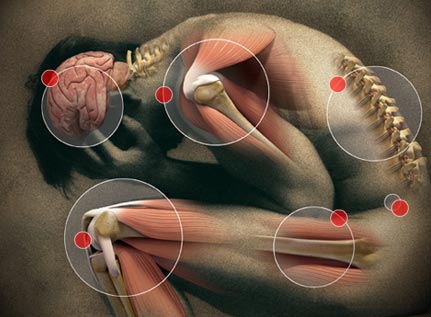
body-pain.jpgOf course, some of us genetically have a higher tolerance for pain. A study at the Cleveland Clinic found that a metal disc heated to 120 degrees and placed on a forearm will be experienced as barely uncomfortable by some and excruciating by others.  Functional brain imaging at the time of the experiment confirms that those who report severe pain actually have greater activation of several areas in the brain that process pain, while those who feel little pain have little brain activation. Thus doctors conclude that, “unless other factors interfere, pain is whatever the patient tells us it is.”  Some of us are able to “cowgirl or cowboy up” better than others.  So if a person you know speaks about their constant pain either accept that as gospel, or avoid the issue.
Pain is a complex experience. Pain is depressing, and depression causes and intensifies pain. People with chronic pain have three times the average risk of developing psychiatric symptoms — usually mood or anxiety disorders — and depressed patients have three times the average risk of developing chronic pain.  When depression is treated, pain often fades into the background, and when pain goes away, so does much of the suffering that causes depression.  Almost every drug used in psychiatry can also serve as a pain medication. But there are other ways to approach the issue.
Cleveland Clinic has some suggestions:
Acceptance: Acceptance does not mean giving up; it means taking charge and having the fullest life possible, despite the pain.
Fitness: Yes, it hurts at first, but trust me, if you stick with it you will see a difference. I did. But don’t expect quick results.  I still need help putting on my right sock but I can sit at a restaurant without putting my leg up on an adjacent chair.  
Stress reduction: Relaxation training, yoga, guided imagery, self hypnosis, and biofeedback training will help harness your ability to learn to regulate the body’s "fight or flight" response that tends to increase pain.  Cognitive therapy can also help, especially if your beliefs about life, yourself, other people or your health situation have become liabilities, interfering with your quality of life more than helping it. For anyone that follows my blogs, you are aware that my journey to find pain relief has figured prominently in what I am interested in and researching--Shamanism, Reiki, plant based medicines, meditation, hypnosis.  Your journey may be different.
Staying active: Sicilian-American anesthesiologist, John Bonica, is known as the founding father of the study of pain management. After years of wrestling caused severe osteoarthritis that he spent his medical career studying and healing from, he noted that patients who have something better to do don’t seem to hurt as much. The converse of this is that if your life is empty, pain will fill it up. When you keep active, you are less aware of pain.  Instead of working less with horses and special needs kids because of the pain, I have tried to work more.  Don’t let pain be your guide, let life be your guide.
Interpersonal support:  The best response for those who love you is to accept that the pain is real, that they can’t take it away, and that you aren’t sick and don’t need to be treated like a child.
Mutual help: Does it feel as though no one can really understand? Not true.  There are several organizations of people with chronic pain that provide education and support. The American Chronic Pain Association  provides a great deal of education to patients and families about pain, how to deal with it, and various treatments for it.

I am about 90% pain free now.  I can sit without pain.  I sleep better.   I am more active than I have been in a long time.  I even started dog agility with my puppy.  After I stopped physical therapy I started my own program, and adjusted it as I saw what helped me and what didn’t.  It has been a long road to get even here and there’s more work to be done.  I am fortunate to have been on a more metaphysical path when all this transpired, so I rely mostly on non-medical treatments for pain relief.  I haven’t become reliant on pain medications as some do.    
I want to remind people that pain is in the mind of the beholder and that the physical body affects mood, depression and vice versa.  Don’t judge until you walk in someone’s shoes.  They may pinch.
 
 ***************
Vera Remes


Vera's Rave'n - The many aspects of Shamanism

Wednesday, November 9, 2016

How mental illnes affects family dynamics


recognize-teenage-substance-abuse.jpg

Living with a loved one suffering with a mental illness can take a lot of understanding and support, working together to find a healthy way to cope.
Gretchen Mullin, a Licensed Mental Health Counselor and Certified Addictions Professional in Tampa Bay, Florida, knows the biggest challenge for families is to understand the specific condition afflicting their loved one.
“Mental illness impacts behaviors and thinking patterns,” Gretchen says.  When observable behavior or cognitive changes occur as a result of a mental illness, it can be confusing, alarming, and even scary for the entire family.”

In her own practice, Gretchen sees how important it is for patients to receive an accurate diagnosis from a qualified professional.  This, in conjunction with psychoeducation, which offers training to patients and their families, can help ease the struggle of dealing with a mental illness as a family.  
 
American Psychological Association
Another challenge faced by families is readjusting expectations.  This is especially true for parents of children dealing with a mental illness.  The American Psychological Association says that regulating hopes and expectations for the future is part of the process, and that it is normal for relatives to experience grief and confusion.
 
For example, families dealing with a mental illness find it easy to become frustrated with the afflicted person.  When a loved one is dealing with depression, for example, it may be easy to say “just pull yourself together and get moving.”  Gretchen finds this to be one of the most common mistakes made in families dealing with a mental illness diagnosis.
 
image description“The best way to rectify this is [to receive an] appropriate diagnosis and subsequent treatment for all parties,” Gretchen said.  “Psychotherapy and appropriate support groups for both family members and the diagnosed individual are pertinent in total recovery.  Equally important is that the family learns appropriate communication skills to discuss symptoms and symptoms management.”
While treating patients and their families, Gretchen tends to run into a common issue: Relatives often do not understand that a mental illness is a medical condition, no different than heart disease or diabetes.  The brain not functioning properly, she explains, causes mental illnesses.  Like any other health condition, the majority of mental health conditions are very treatable, but aren’t something the afflicted person can just ‘shake off’.
 
She says, “People diagnosed with a mental illness can live a fulfilling and meaningful life once treatment is sought.”

 
Although living with a mental illness is challenging, there are many resources to help families thrive.
 
Nami National Alliance on Mental Illness
Triscia Hennessy is a member of the  National Alliance for Mental Illness (NAMI) and a Family to Family NAMI educator.  She’s also the mother of a daughter suffering from borderline personality disorder, anxiety, and depression.  Her personal experience with mental illnesses stresses the importance of seeking help.
 
NAMI is the nation’s largest mental health organization dedicated to building better lives for the millions of Americans affected by mental illness.  As a NAMI educator, Triscia believes family members may become depressed, detached, or even aggressive when coping with an afflicted loved one.
 
She says, “I can’t stress enough the need for what NAMI calls ‘self-care’, to help families get through life with a mental illness in the family.”
 
Family members must take care of themselves during this process.  It is common for them to experience anxiety, a need for reassurance, fatigue and exhaustion.  On their website, NAMI suggests that caregivers pay attention to their own physical and emotional health.  Understanding how stress affects families dealing with a mental illness is key in maintaining optimal health.  
 
Common physical signs of stress include headaches, low energy, insomnia, and upset stomach.
A mental illness diagnosis can be frightening and confusing for everyone, but there is support and resources that help families cope and thrive.  


If your loved one has been diagnosed with a mental illness, please seek support from your healthcare practitioner or any of the following resources.

Tuesday, November 8, 2016

Our Challenges: The worst or best thing to happen to us?

by Barbara Steingas

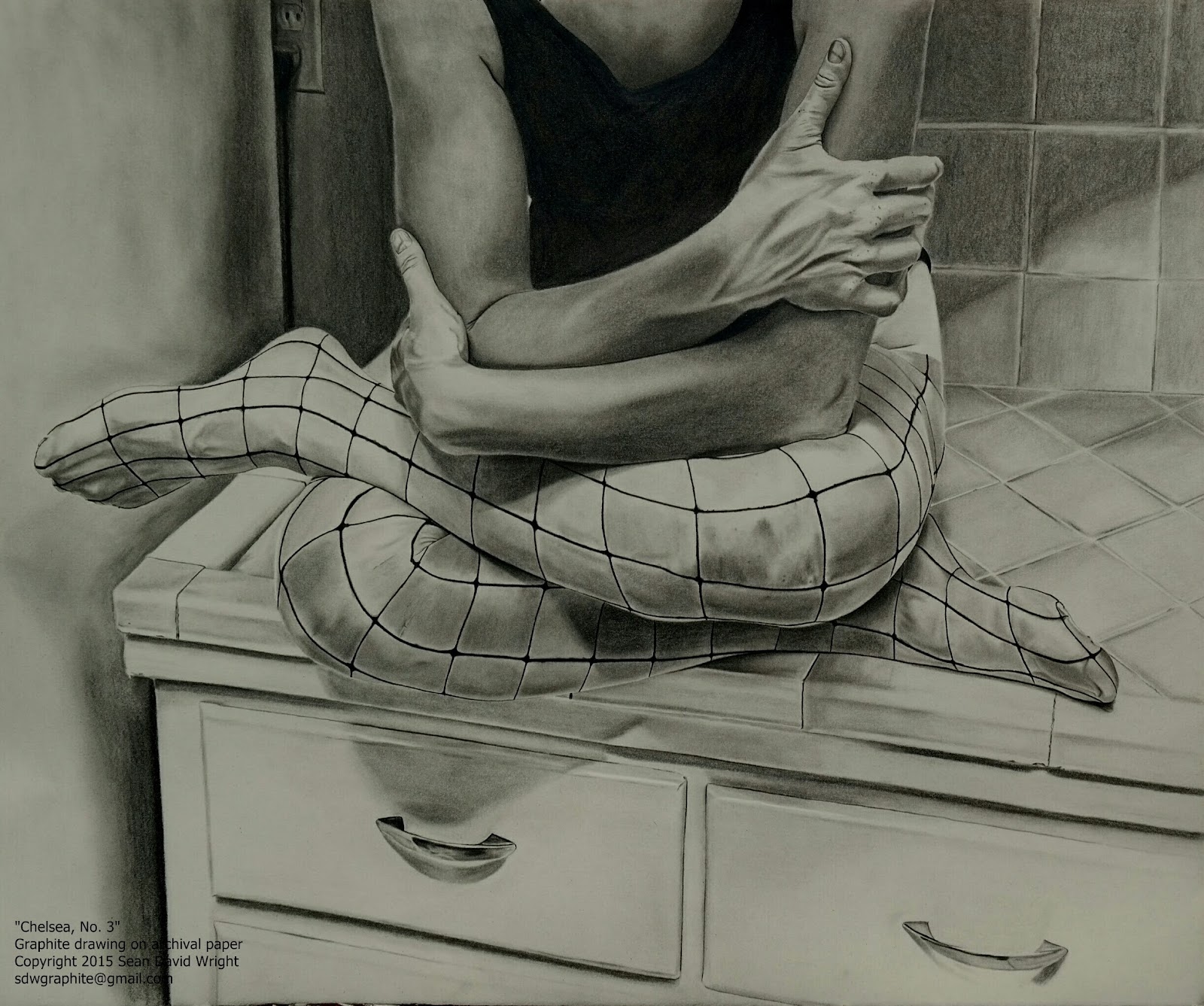
Chelsea_Number3_Watermarked_2.jpg
Chelsea No.3, by Sean David Wright
When we don’t feel worthy of health, happiness, joy and love, challenges tend to leave us feeling victimized. We end up feeling we have no power over our circumstances and have no choice but come to some form of resigned acceptance of our life. However, we have a choice over what we make of any situation. Instead of becoming powerless victims to our circumstances, what if we realized that we have the ability and power to make a choice of how we respond and deal with the situation, of what we make it mean, and how we are going to move forward?
Stories of overcoming challenges have been part of the human experience since the dawn of man. One story that is consistent in all indigenous cultures was uncovered by Joseph Campbell, author of The Hero With A Thousand Faces; the quest to overcome challenges and evil, thereby ultimately becoming the great hero or warrior. This journey is one we all participate in, but because these stories have trained us to believe only a select few are allowed to be the hero or heroine, we have come to believe that if we don't immediately succeed compared to our peers, we are the victim of our personal stories.

The Hero with a Thousand Faces (The Collected Works of Joseph Campbell)This was true for me when I was confronted with a serious illness that was considered incurable. At first, I believed the story of incurability and quickly fell victim to my circumstances. I didn’t question anything and naively believed what I was told. I felt it was the worst thing that had ever happened to me and at some point I would die an early death.  Over time, I got tired of the blind acceptance and I had my epiphany or ah-ha moment. I refused to be a victim and I set out to become the heroine of my own journey. I found my way back to health by making small changes at first.  Eventually I overcame my demons and challenges, become the victor over a seemingly impossible situation and became more than I could have ever dreamed.
Because I chose to take the road less traveled, I discovered that what I thought was the worst thing to ever happen to me was actually a blessing in disguise and one of the best experiences. It made me the person I am today. I found my mission in life by applying what I learned to help those on similar journeys, hopefully sparing them some of the suffering by sharing my own experiences. That is a wonderful feeling and gives my suffering meaning and purpose.
The challenges of my journey have allowed me to expand my heart and ability to love myself and to love others. I feel that is the ultimate reason we are here and are made to go through life’s challenges. When we ride out the storms of our biggest challenges, we can reap our greatest rewards by allowing our light to shine more brightly, becoming more than we thought we could ever be.
Giving back after a traumatic experience is the final, and one of the most important steps, to any long-term recovery program.  No matter whether suffering from a disease like Crohn’s or a disease like alcoholism, helping others through the stages of their journey to recovery encourages us to continue that personal work ourselves as we become a role model for others.
 
********************
Barbara Steingas
 
Live a Radiant Life - Tips to improve health, happiness & joy


Monday, November 7, 2016

Art Therapy to Treat Mental Illness

by Tamara Rokicki

The struggle with mental illness can be a long and painful journey.  Healing and support come in many forms and suffering individuals can choose to utilize mainstream or alternative tools in their healing journey.  Current research is spotlighting art therapy as a creative outlet in finding a way to cope with mental illnesses and stress.
 
The American Art Therapy Association promotes the use of art media to resolve conflicts and problems, develop interpersonal skills, manage behavior, reduce stress, increase self-esteem and self-awareness and achieve insight.
 
The power of art therapy has transformed Amy Oestreicher, who survived a coma, 27 surgeries, sexual abuse, and medical trauma.   After spending three months at Yale Hospital, unable to eat or drink, Amy found an outlet through art.  It was the beginning of a new journey for Amy, one that would help her deal with everything happening in her life.  She explains that once she discovered painting, her world changed. Through art she was able to express things that were too painful or complicated for words.
 
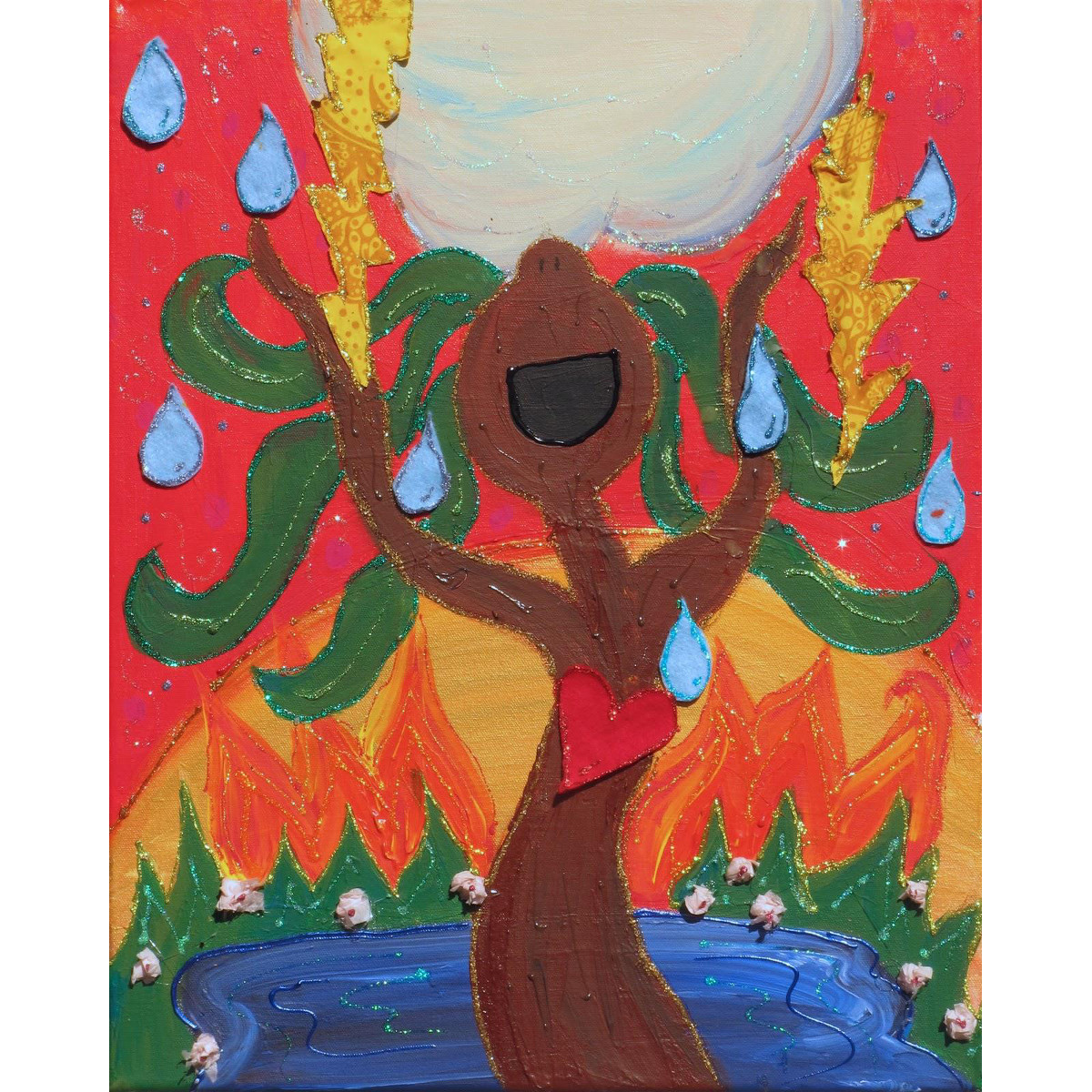
singing-tree.jpg
Singing Tree, Amy Oestreicher
“Singing Tree”  (right) was Amy’s first art project that she completed while hospitalized.  As she struggled with anxiety and confusion, creating her first artwork helped her replace trauma with hope.  
 
Amy recalls, “Every tree seems to be singing and dancing, although the teardrops and lightning bolts are always streaked across the bold backgrounds. Even though [it was] sadness [prompting] me to paint, the act of painting became joyful.   By the time I finished a painting, I was exhausted and oddly happy. By painting, I could see what I was feeling. And to know I could feel at a time when every surgery made me feel more and more like a robot, well, that just made me very happy.”
 
Art therapy focuses on creating images when words can’t describe the trauma.
 
In the the National Institute of Health’s article How Arts Affect Your Health, Megan Robb, a certified therapist at NIH’s Clinical Center, explains, “When traumatic memories are stored in the brain, they’re not stored as words but as images.  Art therapy is uniquely suited to access these memories.”  
 
Art therapy helps externalize trauma and view it as a positive exchange.  Robb believes that this process allows “an active involvement in your own healing.”
 
Art therapy is a creative process that can be beneficial to anyone, regardless of his or her artistic level or background.  For example, Amy’ own background did not include artistic training, and she considers this a blessing.
 
She says, “Not being savvy with technical art terms is an advantage when my lines aren’t perfectly shaped or my colors aren’t seamlessly blended. My oblivion and unashamed passion helped to silence my inner critic. Whatever I paint, I create from the heart. I try to focus on the physical sensations of feeling my brush glide across the canvas, drenched in a juicy glob of heavy-bodied paint. I feel the bristles press against the stretched linen; I see each fiber drag across a mound of cherry-apple red. As I guide my brush up and down my canvas, the repetitive gestures become meditative.”
 
Art therapy promotes well-being for people suffering with mental illness, stressful life changes, and post traumatic stress disorder (PTSD).
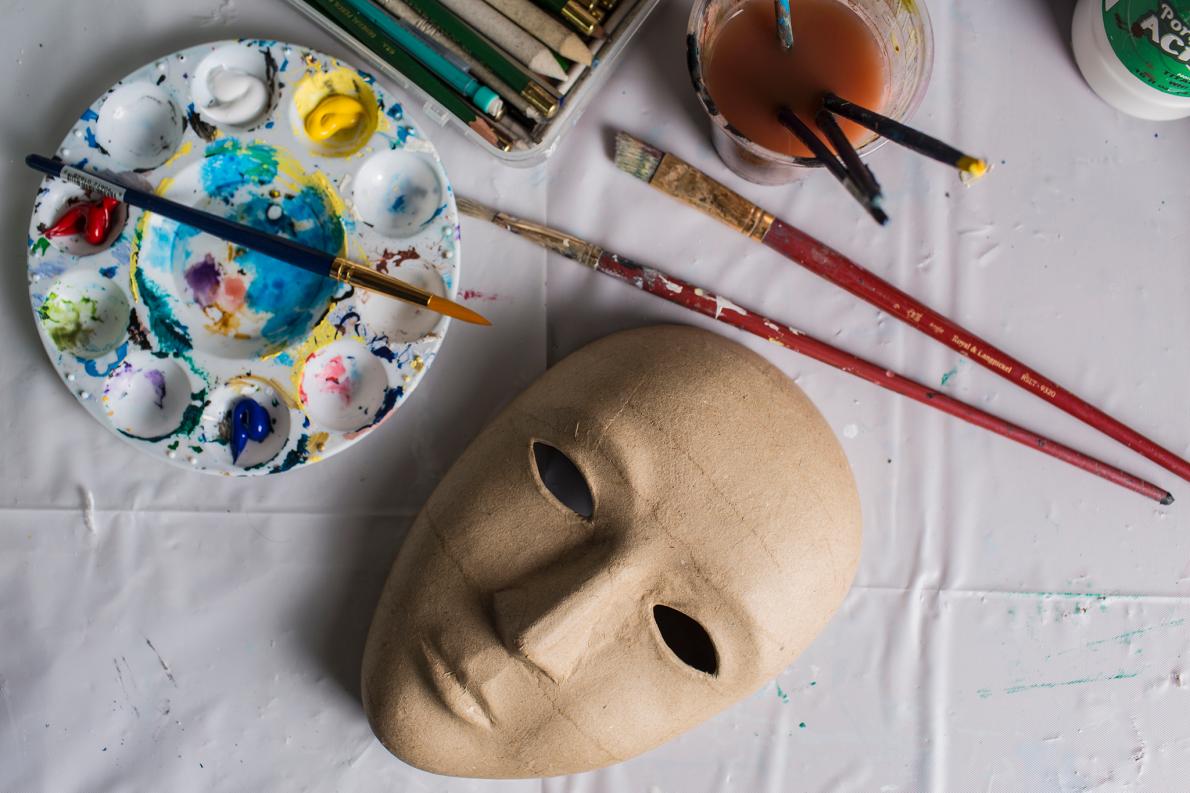
88451.adapt.1190.1.jpg
Photography by Rebecca Hale, National Geographic

Melissa Walker, an art therapist at the National Intrepid Center of Excellence, works with service members suffering traumatic brain injury and psychological health conditions.  In the National Geographic article How Art Heals the Wounds of War, Melissa shares how she implements art therapy in treating returning injured men and women.  She provides service members a blank papier-mâché mask, and asks them to decorate it. The final product shows the psychology of pain, something that not even high-tech neuroimaging machines can detect.  By painting the mask, service members are able to express what they are feeling in art form, opening a door to conversation with their social worker or psychiatrist.  
 
The arts demonstrate that creative expression will lead to better well being.  Whether it’s musical expression, painting or even cooking, any creative outlet can help reduce stress and trauma related to health issues or life circumstances. 

 
To help Amy Oestreicher in her journey to create inspirational media, articles and tutorials for others in need of healing, become a patron at patreon.com/amyo.  You can also listen to how she has been inspired her to transform obstacles in her path into opportunities for growth.
Learn more of the story behind it here - https://amyoes.com/2016/06/17/tedx-video/

Friday, November 4, 2016

NaNoWriMo - helpful websites


Think ahead: Mind Key's Great American Novel Package will provide everything your finished novel needs to get published. Learn more at www.mindkey.me/store


November is National Novel Writing Month (NaNowriMo) where writers from all around the world have one month to write 50,000 words. Below are helpful resources to help writers prepare and gear up for the challenge. Good luck and most importantly have fun!
This site offers 24/7 writing help on plot, character, and world building and is helpful for readers, writers, poets, and more.
Many times writers have an idea, but don’t know exactly how they want their story to go. This website has different worksheets that can help a writer organize, and plan out their story. Subscribing via email will send updates of new blog posts and when new worksheets are added.
Find PDF Worksheets on:
  • Starting Writing, Genre Help, Plotting Help, Writing Help, Character help, World Building Help, and more.
  • Includes a  “Preparing for Nanowrimo or camp Nanowrimo” section that includes tips, and pdf worksheets to help you during and after NanoWriMO .
  • Take a look at this point-of-view worksheet to determine a point of view for a story.   They have decision making, rites and rituals, narrator etc.
Join a “coterie culture”  
What is a coterie?
According to Eva Deverell, “Coteries were formed for authors to privately circulate manuscripts among friends and acquaintances, for the purposes of discussion, feedback, or entertainment, without actually publishing. Sometimes the material could not be published because it was too dangerously seditious, sometimes circulation among the coterie was a prelude to publication, and at other times the writer created work simply for fun, without the express intention of wider distribution.


2) NaNoWriMo Boot Camp: The Writersaurus    
The Writersaurus helps writers prepare for the month-long challenge of NaNoWriMo. This website  is filled with  workshops, blog posts, and prompts. Writersaurus also provides weekly writing prompts on its pinterest page,  and a catalog of prompts and ideas.


3)   BRIDGID GALLAGHER   
Enthusiast, blogger, and fiction writer Bridgid Gallagher, helps writers and provides different tools. Email subscribers  receive access to her library of resources.  As an added bonus, Bridgid offers a free sixteen page novel called Writer’s Story Workbook. This website not only provides   a blog ideas to help improve your craft, books, magic interviews with authors, and resources for writers and authors, but it provides free courses on how to get strategic about your online presence.  

4.) Have a twitter? Follow:
@NanoWordSprints for word sprints.
@NaNoPals helps writers connect for help on publishing and ideas.
@NaNoWriMo is affiliated with  Camp NaNoWriMo, allowing you to track your progress, get the support you need, and complete a writing project in a month.  #nanocoach
**Meet and greet with each other by hashtagging  #NaNoPals**

Ready for the next step?  Mind Key offers great editing services for getting your finished novel ready for “the show.”  Keep the end in sight, and let Mind Key help you get your work accepted by an agent or publishing house, or let us help you get your novel self-publish ready.  Learn more at www.mindkey.me/store, or by contacting danielle@mindkey.me

 
Back To Top
Copyright © 2014 Mind Key, the blog. Designed by OddThemes